Unpaid construction invoice: get paid quickly
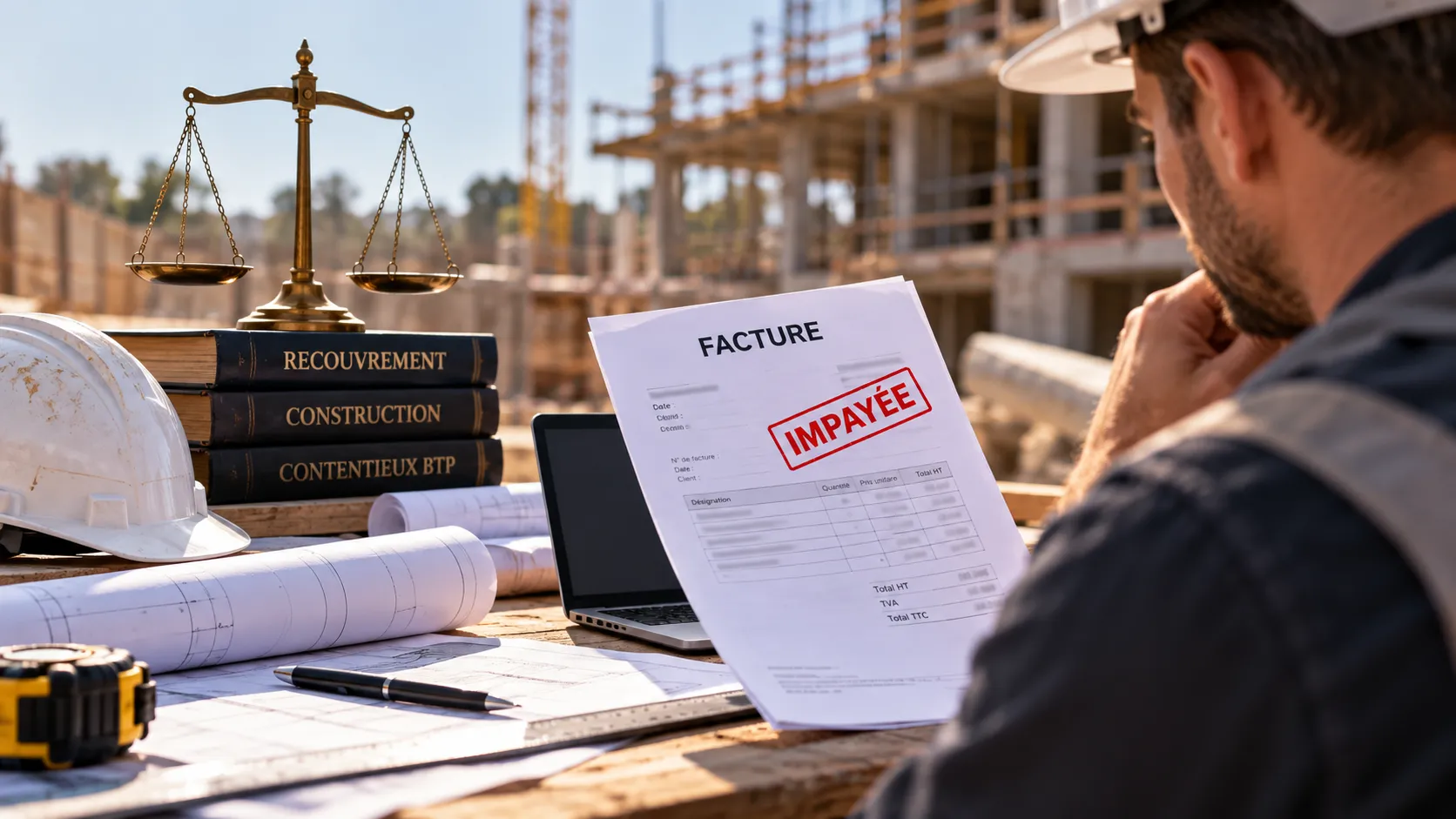

Your client is not paying your invoice? A main contractor refuses to pay for your work? A progress payment claim remains unpaid?
NOVLAW Avocats assists tradespeople, contractors, subcontractors and construction companies with the recovery of their unpaid invoices and progress payment claims.
Plumbers, electricians, joiners, painters, bricklayers, roofers, structural and finishing works companies: we step in when reminders are no longer enough.
Construction law gives building companies protections that few tradespeople actually use: payment guarantees, strict rules on retention money, and the subcontractor's direct claim against the project owner. Our role is to identify the most effective legal lever to secure payment, whether by negotiation or before the court.
Your client refuses to pay for your work?
We act in particular where:
- a private client does not pay the balance for your work;
- a business does not pay an invoice that has fallen due;
- a main contractor does not pay its subcontractor;
- a progress payment claim remains unpaid;
- your client suddenly disputes the work carried out;
- additional work has been carried out but not paid for;
- the project owner relies on defects or reservations to withhold payment;
- retention money has not been released more than a year after handover;
- your reminders and letters go unanswered;
- your debtor is starting to run into financial difficulties.
In construction, an unpaid invoice quickly weighs on cash flow: materials, suppliers, employees and subcontractors must be paid while you wait to be paid for the project.
Acting quickly is not only a matter of cash flow: some statutory time limits are short, particularly against a private client.
Legal levers specific to the construction sector
Recovering a construction invoice involves far more than sending a reminder. Several mandatory statutory provisions specifically protect building companies.
The payment guarantee (article 1799-1 of the Code civil)
Under a private works contract, the project owner must guarantee to the contractor payment of the sums due above a threshold set by decree, currently €12,000 excl. VAT, after deducting any deposits and advance payments made on signature (article 1799-1 of the Code civil (French Civil Code); decree no. 99-658 of 30 July 1999).
- Professional project owner (company, developer, SCI property company, trader): the guarantee takes the form of a joint and several bank guarantee or another guarantee provided for in the contract.
- Private individual project owner: the guarantee only applies if the works are financed by a dedicated loan; the bank may then release the funds only to the contractor.
This guarantee is a matter of public policy: the contractor cannot waive it and may demand it while the works are under way. As long as it has not been provided and completed work remains unpaid, the contractor may suspend the works after a formal notice has gone unheeded for fifteen days.
Retention money (law no. 71-584 of 16 July 1971)
Retention money is capped at 5% of the amount of interim payments and must be deposited with a third party or replaced by a bank guarantee. Its sole purpose is to guarantee that the reservations made at handover are lifted.
Once one year has elapsed from handover, with or without reservations, the retention must be released, unless the project owner has served a reasoned objection based on the contractor's failure to perform its obligations, notified by registered letter. An unjustified objection exposes the project owner to damages. These rules also apply to subcontracts.
Late payment penalties and interest
- Between businesses: late payment penalties and the fixed €40 compensation for recovery costs are due automatically, without any reminder (articles L. 441-10 and D. 441-5 of the Code de commerce).
- Against a private individual: the sums due bear interest at the statutory rate from the date of formal notice (article 1231-6 of the Code civil).
How can you recover an unpaid construction invoice?
Before taking any action, our lawyers review the quotation or contract, the invoices and progress claims, the correspondence with the client, the handover report, any reservations and the evidence of performance. This analysis determines the fastest and safest route.
1. Formal notice to pay
A formal notice sent by a lawyer sets out the claim, starts late payment interest running and is often a mandatory prerequisite: for suspending the works where no payment guarantee has been provided, or for the subcontractor's direct claim. It is frequently enough to unlock payment.
Please note: a formal notice does not interrupt the limitation period. Only an acknowledgement of debt, a court claim (even for interim relief) or an enforcement measure has that effect (articles 2240 and 2241 of the Code civil).
2. Negotiation and amicable recovery
The client acknowledges the debt but asks for more time? Part of the invoice is disputed? We negotiate a settlement, a payment schedule or a written agreement securing payment. A signed payment schedule amounts to an acknowledgement of debt and restarts the limitation period.
For claims of €5,000 or less brought before the tribunal judiciaire, a prior attempt at conciliation, mediation or participatory procedure is in principle mandatory, failing which the claim is inadmissible (article 750-1 of the Code de procédure civile).
3. Order for payment
Where the claim is contractual and for a fixed amount, the order for payment procedure (injonction de payer) (articles 1405 et seq. of the Code de procédure civile) makes it possible to obtain an order from the judge without a hearing. If the debtor does not lodge an objection within one month of service, it becomes an enforceable title.
It is suited to undisputed invoices. Where a client is already alleging defects, an objection is likely and another route is often faster.
4. Interim payment order (référé-provision)
Where the obligation to pay is not seriously disputable, the interim relief judge may order the debtor to make an interim payment (article 835, paragraph 2, of the Code de procédure civile before the tribunal judiciaire; article 873, paragraph 2, before the commercial court).
It is one of the most effective urgent procedures, particularly well suited to approved progress claims, accepted additional work and disputes between a main contractor and a subcontractor.
5. Protective measures
If recovery appears to be at risk, the judge may authorise a protective attachment (of bank accounts in particular) even before judgment, provided the claim appears well founded in principle (article L. 511-1 of the Code des procédures civiles d'exécution).
6. Proceedings on the merits in the event of a serious dispute
Defects, unfinished work, delays, disagreement over the price or over additional work: where the dispute goes beyond the powers of the interim relief judge, we pursue your claim for payment before the competent court, requesting a court-appointed expert assessment where necessary.
Your client alleges defects to avoid paying?
This is a common situation: after several reminders, a client who had raised no issue suddenly alleges defects or unfinished work to justify non-payment.
A dispute does not wipe out your claim. The law strictly limits the right to withhold the price:
- The defence of non-performance must be proportionate. A client may only suspend payment if the non-performance is sufficiently serious (article 1219 of the Code civil). A minor reservation does not justify withholding the entire invoice.
- A price reduction requires a procedure. A client who considers itself wronged may seek a proportionate reduction in the price, after serving formal notice (article 1223 of the Code civil). It cannot take the law into its own hands by keeping the full amount.
- Handover is a key moment. It marks acceptance of the works, with or without reservations (article 1792-6 of the Code civil). Apparent defects not reserved at handover are in principle covered by it, and the reservations made define what the client can raise against you.
NOVLAW assesses how robust the dispute is: the nature of the defects, the reservations actually made, the evidence of performance. We then claim the sums that remain due, where appropriate through an interim payment order for the undisputed portion.
Additional work: can it be invoiced?
It all depends on the type of contract.
- Lump-sum contract: the contractor may only claim extra payment for changes or additions if they were authorised in writing and their price agreed with the project owner (article 1793 of the Code civil). A signed works order, an amendment or an accepted supplementary quotation is then decisive.
- Other contracts (estimate-based, cost-plus or measured contracts): the order and acceptance of the work may be established through written exchanges, site meeting minutes or approved progress claims.
Additional work is one of the leading sources of disputes in construction: recording every client request in writing, even by e-mail, is the best prevention.
Subcontractor: the main contractor is not paying you?
An unpaid subcontractor is not limited to a claim against the main contractor. Law no. 75-1334 of 31 December 1975 on subcontracting, a matter of public policy, gives it additional safeguards, including where the main contractor defaults.
The direct claim against the project owner
If the main contractor does not pay one month after being served with formal notice, the subcontractor may bring a claim directly against the project owner. A copy of the formal notice must be sent to the project owner (article 12). Any waiver clause is deemed unwritten.
The direct claim is limited to the sums the project owner still owes the main contractor on the date it receives that copy (article 13). Hence the importance of acting quickly. The Cour de cassation has confirmed that the direct claim is only available after a formal notice has gone unheeded for one month (Cass. 3e civ., 15 septembre 2016, n° 15-22.592).
Bank guarantee or delegation of payment
In a private contract, payments due to the subcontractor must be secured by a personal, joint and several bank guarantee, unless the project owner has delegated payment to the subcontractor (article 14). Failing this, the subcontract is liable to be declared void, which opens other avenues of remuneration to the subcontractor.
Subcontractor not approved: the project owner's liability
A project owner who is aware of the presence of a subcontractor that has not been approved must serve formal notice on the main contractor to regularise the situation (article 14-1). If it fails to do so, it may be held liable to the unpaid subcontractor, particularly where the main contractor is in liquidation.
NOVLAW acts to recover sums owed to subcontractors: unpaid invoices and progress claims, disputed additional work, unjustified retentions, disagreements over the final account.
For example, NOVLAW assisted a subcontractor specialising in concrete sawing and core drilling, faced with non-payment of an invoice of more than €128,000 excl. VAT for additional work. The firm obtained an interim order requiring the main contractor to make an interim payment.
Are you a subcontractor with an unpaid invoice? Contact us.
Limitation: how long do you have to act?
The time limit depends on who your client is. Against a private individual, it is particularly short.
- Private client (consumer): 2 years (article L. 218-2 of the Code de la consommation).
- Professional client (business, trader, company): 5 years (article L. 110-4 of the Code de commerce; article 2224 of the Code civil).
For a claim for payment for construction work, time in principle runs from completion of the works or performance of the services, not from the date the invoice was sent (Cass. 3e civ., 1er mars 2023, n° 21-23.176). Invoicing late therefore does not extend the time limit.
Reminder: a chaser or a formal notice, even by registered letter, does not interrupt the limitation period.
Is your debtor in financial difficulty?
If your client is subject to safeguard proceedings, judicial reorganisation or judicial liquidation, you must file a proof of claim with the creditors' representative within two months of publication of the opening judgment in the BODACC (article R. 622-24 of the Code de commerce). After that deadline, the claim cannot be enforced in the proceedings, unless relief from the time bar is granted.
In this situation, the safeguards specific to construction come into their own: the payment guarantee under article 1799-1, the guarantee under article 14 of the 1975 law, and the subcontractor's direct claim against the project owner. They make it possible to be paid by a solvent third party rather than waiting for a distribution that is often nil.
Which documents should you send your lawyer?
For an initial review, please gather where possible:
- the quotation or works contract, and the type of contract (lump sum or not);
- the unpaid invoice and the progress claims;
- works orders, amendments or purchase orders, particularly for additional work;
- the subcontract and, where applicable, the project owner's deed of approval;
- e-mail or text message exchanges and site meeting minutes;
- the reminders already sent;
- photographs of the site;
- the handover report and any reservations;
- any payment guarantee or bond provided by the client.
Even if your file is incomplete, we can review it.
Why entrust your unpaid invoice to NOVLAW Avocats?
From negotiation to litigation, a single point of contact. If the formal notice has no effect, the firm takes the matter to court directly.
Experience in commercial and construction litigation. NOVLAW acts in commercial litigation, real estate and construction law, and is familiar with the mechanisms specific to the construction sector: payment guarantees, retention money, subcontracting.
A strategy proportionate to the amount at stake. Bringing costly proceedings over a small invoice does not always make sense. We choose the route suited to the amount and to the debtor's solvency.
We act throughout France. Paperless file management and electronic signature.
How much does it cost to recover an unpaid invoice?
The cost depends on the amount, on whether the claim is disputed and on the procedure required. At NOVLAW Avocats, fees start from €250 excl. VAT for a formal notice and from €950 excl. VAT for certain straightforward court procedures. A quotation is provided before any work begins.
Between businesses, the fixed €40 compensation is due automatically. The judge may also order the losing party to reimburse all or part of your legal fees (article 700 of the Code de procédure civile). To find out more: how much do commercial proceedings cost?
You have done the work. Get paid for it.
If your reminders go unanswered or your client keeps putting off payment, NOVLAW Avocats takes over the file and takes the steps needed to secure payment. Send us your invoice and the main project documents.
See also: breach of a commercial contract: what remedies are available to a business?
Are you a freelancer or consultant? Discover our dedicated service for the recovery of unpaid fees for freelancers and consultants.
FAQ – Unpaid invoices for tradespeople and construction companies
My client refuses to pay the invoice for my work: what should I do?
Keep everything that proves the order and the performance of the work: quotation, invoice, correspondence, photographs, handover report. After a reminder, a formal notice can be sent by a lawyer. If it has no effect, an order for payment or an interim payment order makes it possible to obtain a decision quickly where the debt is not seriously disputed.
How long do I have to claim payment for my work?
Two years against a private client (article L. 218-2 of the Code de la consommation), five years against a business. Time in principle runs from completion of the works, not from the date of the invoice. A formal notice does not interrupt this time limit.
Can I claim payment of an invoice if the client did not sign the quotation?
The absence of a signed quotation makes proof more difficult but does not make the invoice unrecoverable. E-mails, text messages, deposits paid, site meeting minutes or acceptance of the work may establish the order. Against a private individual, the rules of evidence are stricter above €1,500: each case must be assessed individually.
My client alleges defects: can they refuse to pay the whole invoice?
Not automatically. The client may only suspend payment if the non-performance is sufficiently serious, and any price reduction must be proportionate. The reservations made at handover in principle define what the client can raise.
When should I get my retention money back?
No later than one year after handover of the works, even with reservations, unless the project owner has notified a reasoned objection by registered letter (law no. 71-584 of 16 July 1971). The retention may not exceed 5% of the amount of interim payments.
What is the payment guarantee under article 1799-1 of the Code civil?
For a private contract worth more than €12,000 excl. VAT, a professional project owner must guarantee payment to you, usually through a bank guarantee. You can demand it at any time, even after signature. Failing this, you may suspend the works after a formal notice has gone unheeded for fifteen days.
A main contractor is not paying my subcontracting invoice: what should I do?
Serve formal notice on it by registered letter and send a copy to the project owner. If it does not pay within one month, you may bring a direct claim against the project owner, up to the amount the project owner still owes the main contractor (law no. 75-1334 of 31 December 1975).
Can I recover payment for additional work not included in the quotation?
Under a lump-sum contract, only if the work was authorised in writing and its price agreed with the project owner (article 1793 of the Code civil). Under other contracts, the order may be proven by written exchanges and site meeting minutes.
How long does it take to recover an unpaid invoice?
It all depends on how the debtor reacts. A formal notice is sometimes enough to obtain payment within a few days. An interim payment order generally takes a few weeks to a few months; proceedings on the merits with an expert assessment take longer.
Frequently asked questions on
Debt recovery
What means are available to recover an unpaid debt between businesses?
Several routes are available to recover a debt between businesses: formal notice by registered letter with acknowledgement of receipt (the starting point for late-payment interest); an order for payment (injonction de payer: a rapid procedure, initially without the debtor being heard, for debts that are certain and due); a summons for an interim payment in summary proceedings (référé-provision) before the president of the commercial court (for debts that cannot seriously be disputed); and a summons on the merits if the debt itself is disputed.
What is an order for payment (injonction de payer) and how does it work?
The order for payment (injonction de payer) is a simplified procedure enabling a creditor to obtain an enforceable title quickly against a defaulting debtor. The application is filed with the registry of the competent court. If the judge grants it, he or she issues an order for payment, which must be served on the debtor by a bailiff. The debtor has one month to lodge an objection. If no objection is lodged, the order is endorsed with the enforcement formula and allows the creditor to carry out seizures.
Can a bailiff be used to recover a debt without going to court?
Yes. Since 2012, a commissaire de justice (formerly huissier de justice, or bailiff) can be instructed to carry out an amicable recovery procedure for small debts (up to €5,000) owed by individuals, without first going to court. If the debtor agrees to pay, an agreement is formalised. This procedure is quick (less than 3 months) and inexpensive. If it fails, it is still possible to bring ordinary court proceedings.
Have your unpaid invoice reviewed
Send us your invoice and the main project documents: we will promptly tell you the most effective lever for securing payment, whether by negotiation or before the court.